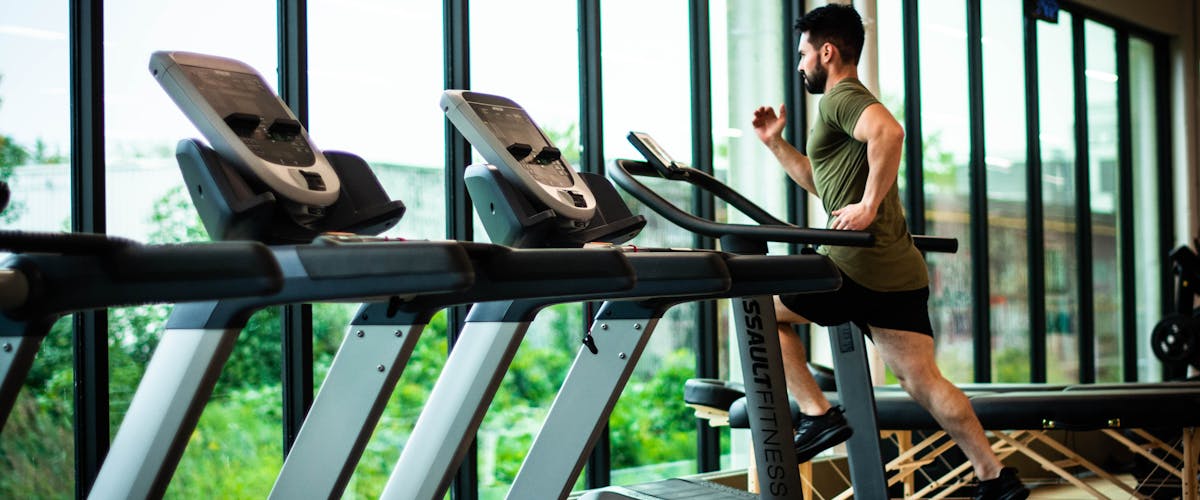
For bad knees, the elliptical is the better choice: the gliding motion is zero-impact and keeps feet in contact with the pedals at all times, unlike the repetitive heel strike on a treadmill that multiplies body weight on the knee joint with each stride. The Arthritis Foundation recommends ellipticals as a low-impact cardio option for people with joint pain. However, walking on a well-cushioned treadmill at a 2% incline is also knee-safe — it is running on a treadmill that creates the problem.
The top Google results for "treadmill or elliptical for bad knees" come from Cleveland Clinic and Healthline. Both articles answer the medical question well but stop there — neither recommends a single machine, compares specific models, or helps with the buying decision. This guide covers the biomechanics AND tells readers exactly what to buy, with five specific machines tested and evaluated for knee-friendliness.
The Short Answer — Elliptical Wins for Bad Knees (But There's a Catch)
Why the Elliptical Is Kinder on Knees
The elliptical eliminates impact by design. Feet remain planted on the pedals throughout the entire stride cycle — there is no moment where the foot leaves the surface, strikes the ground, and sends a shockwave up through the ankle, knee, and hip. That single mechanical difference is why the elliptical is recommended by the Arthritis Foundation for people with osteoarthritis (OA) and chronic joint pain.
The smooth, oval pedal motion also keeps the knee tracking in a relatively neutral alignment. There is no lateral movement, no sudden deceleration, and no uneven surface to adapt to. Research comparing ground reaction forces during treadmill running versus elliptical training has consistently shown that the elliptical produces significantly lower joint loads — in some studies, approaching the force levels of walking.
The elliptical also offers a full-body workout when used with the moving handlebars, distributing effort across the upper and lower body. This further reduces the percentage of work that the knee joint handles during a session compared to treadmill-only cardio.
When a Treadmill Is Still OK for Bad Knees
The treadmill is not inherently bad for knees — running on a treadmill is. This distinction matters because many people with mild knee issues can walk on a treadmill safely and benefit from it in ways an elliptical cannot provide.
Walking on a treadmill at a 2% incline reduces knee joint force by shifting muscular load toward the glutes and hamstrings. Research shows that this slight incline change can decrease patellofemoral joint stress by approximately 24% compared to flat walking. Modern cushioned treadmill decks further absorb shock — a meaningful upgrade over walking on concrete, asphalt, or even gym floors.
Crucially, treadmill walking is a weight-bearing exercise. Ellipticals are not. For individuals at risk of osteoporosis — particularly postmenopausal women — weight-bearing activity stimulates bone density maintenance in ways that non-weight-bearing machines cannot replicate. A doctor may specifically recommend treadmill walking over elliptical training for patients whose bone health is a concern alongside knee health.
The takeaway: the elliptical is the safer default for bad knees. But walking on a cushioned treadmill at a low incline remains a viable and sometimes medically preferable option — especially for those who need weight-bearing exercise.
The Science — What Happens to Knees on Each Machine
Treadmill Biomechanics and Joint Impact
Running generates ground reaction force of 2–3 times body weight per foot strike. For a 180-pound person, that means each stride sends 360–540 pounds of force through the knee joint. At a running cadence of 160–180 steps per minute, the cumulative load over a 30-minute run is staggering.
Walking on a treadmill tells a very different story. Walking generates roughly 1.0–1.5 times body weight in ground reaction force — dramatically less than running and comparable to what an elliptical produces. Speed matters more than the machine: a person walking at 3.0 mph on a treadmill is subjecting the knee to roughly the same force as a person using an elliptical at moderate intensity.
This means the real comparison is not "treadmill vs. elliptical" but "running vs. gliding." For anyone committed to walking-only treadmill use, the impact difference between the two machines is far smaller than commonly believed.
Elliptical Biomechanics and Why It Works
The elliptical's defining mechanical feature is continuous foot-pedal contact. Because the feet never leave the pedals, the ground reaction force approaches zero — there is no impact event at all. The knee flexes and extends in a controlled arc that closely mirrors a natural walking gait without the deceleration forces of heel strike.
Reverse pedaling — available on most modern ellipticals — adds another dimension. Pedaling backward shifts muscular emphasis toward the quadriceps and further reduces patellofemoral compression. A 2021 study cited by Medical News Today found that low-incline, reverse-direction elliptical training was particularly beneficial for individuals with knee osteoarthritis, improving both pain scores and functional mobility over an 8-week period.
The combined benefit is significant: the elliptical allows high-intensity cardiovascular training while generating joint loads closer to those of seated cycling than of any form of upright locomotion. For anyone dealing with arthritis, meniscal damage, or post-surgical recovery, this makes the elliptical a uniquely capable machine.
What to Look For in Equipment for Bad Knees
For Ellipticals — 4 Features That Matter
- Adjustable stride length. A longer stride produces a more natural gait pattern and reduces the amount of knee flexion per revolution. Look for machines with at least 18–20 inches of stride length; adjustable-stride models (like the NordicTrack FreeStride) allow customization to individual leg length and comfort.
- Smooth drive system. Belt-driven ellipticals are quieter and produce a smoother pedal path than chain-driven models. Smoother motion means less jerky knee movement, which matters for inflamed or recovering joints.
- Reverse pedaling capability. Not all budget ellipticals support reverse motion. This feature is important for targeting different muscle groups and reducing anterior knee stress.
- Rear-drive vs. front-drive. Rear-drive ellipticals generally produce a more linear, flatter pedal motion that feels closer to walking. Front-drive models create a steeper, more climbing-style arc. For bad knees, the flatter rear-drive motion is typically more comfortable.
For Treadmills — 4 Features That Matter
- Cushioning deck technology. Look for treadmills that advertise specific shock absorption systems. Brands like Sole (FlexWalk cushioning) and NordicTrack (FlexSelect) allow users to adjust deck firmness. A well-cushioned deck can reduce impact by 15–40% compared to road running.
- Belt width of at least 20 inches. A wider belt allows a more natural walking stance without worrying about stepping off the edge. This prevents compensatory movement patterns that can stress the knee laterally.
- Precise speed control. The ability to set walking speed in 0.1 mph increments matters for people who need to stay in a comfortable walking range (typically 2.0–3.5 mph). Avoid machines that only adjust in 0.5 mph jumps.
- Sturdy handrails. During knee flare-ups, handrails provide balance and allow partial upper-body support that reduces lower-body load. Rails should be positioned at a natural grip height, not awkwardly high or low.
The Best Ellipticals for Bad Knees — 3 Picks
Best Overall — Sole E35
The Sole E35 combines the features that matter most for knee health: a 20-inch stride length, whisper-quiet belt-drive system, and a heavy 25-pound flywheel that creates one of the smoothest pedal motions in its price class. The adjustable pedal angle allows customization of foot positioning to reduce ankle and knee strain. At approximately $1,099, it sits at the sweet spot between budget models that cut corners on smoothness and premium machines that add features most home users do not need.
The E35 supports reverse pedaling, has a rear-drive design, and includes 20 levels of magnetic resistance — enough range for both rehabilitation-level sessions and high-intensity interval training. The frame carries a lifetime warranty; parts and electronics are covered for 5 years.
Sole E35 Elliptical
- 20" stride length with adjustable pedal angle
- 25 lb flywheel — rear-drive, belt-driven for smooth motion
- Reverse pedaling for quad-focused, low-stress training
- Lifetime frame warranty, 5-year parts coverage
Best Budget — Schwinn 490 Elliptical
Under $700, the Schwinn 490 is the best option for knee-conscious buyers on a budget. The 18-inch stride length is shorter than the Sole E35 but adequate for most users under 6 feet tall. The magnetic resistance system offers 16 levels with smooth transitions, and the machine supports both forward and reverse pedaling.
The trade-off at this price is build quality — the Schwinn 490 has a lighter flywheel and a less robust frame compared to the Sole. For users who plan to exercise 3–4 times per week at moderate intensity, it performs reliably. For daily heavy use, investing in the E35 or FS10i is worthwhile.
Schwinn 490 Elliptical
- 18" stride with forward and reverse pedaling
- 16 levels of magnetic resistance
- Bluetooth connectivity and built-in workout programs
- Best value under $700 for knee-safe cardio
Best Premium — NordicTrack FreeStride FS10i
The NordicTrack FreeStride FS10i is not a traditional elliptical — it is a stride trainer that adjusts from 0 to 32 inches of stride length, effectively combining an elliptical, stepper, and treadmill in a single machine. This adjustability is the FS10i's key advantage for bad knees: the stride length can be shortened during flare-ups and gradually increased as comfort improves. No other home elliptical offers this kind of progressive customization.
The FS10i integrates with iFIT for instructor-led workouts that automatically adjust stride length and resistance during class — useful for guided rehabilitation sessions. The 32-pound inertia-enhanced flywheel produces exceptionally smooth motion. At ~$1,699, it is a significant investment, but the stride flexibility makes it uniquely suited for users managing ongoing knee conditions. For context on how premium connected fitness machines compare on content and value, the Hydrow vs. Ergatta comparison covers similar subscription-based considerations.
NordicTrack FreeStride FS10i
- Adjustable 0–32" stride — adapts to knee condition day by day
- 32 lb inertia-enhanced flywheel for ultra-smooth motion
- iFIT integration with auto-adjusting instructor-led workouts
- Functions as elliptical, stepper, and stride trainer in one
The Best Cushioned Treadmills for Bad Knees — 2 Picks
For those whose doctor recommends weight-bearing exercise, or who simply prefer walking, these two treadmills offer the best combination of deck cushioning and joint-friendly features.
Best Overall Treadmill — Sole F85
The Sole F85 features the brand's FlexWalk cushioning system — a deck that absorbs significantly more impact than standard treadmill surfaces. Independent testing has shown Sole's cushioned decks reduce joint impact by up to 40% compared to road surfaces. The 22-inch-wide belt is among the widest available in home treadmills, allowing a natural walking gait without lateral constraint.
Speed adjusts in 0.1 mph increments from 0.5 to 12 mph, and the incline range (0–15%) makes it easy to set the 2% grade that research suggests is optimal for reducing knee stress. The F85 also includes a 4.0 CHP motor — far more than needed for walking, which means it runs cooler and quieter at low speeds. The frame carries a lifetime warranty.
Sole F85 Treadmill
- FlexWalk cushioning — up to 40% less impact than road surfaces
- 22" wide belt for natural walking stride
- 0–15% incline with 0.1 mph speed increments
- 4.0 CHP motor — lifetime frame warranty
Best Under $1,300 — ProForm Pro 2000
The ProForm Pro 2000 offers a cushioned deck system (ProShox) and a 20-inch belt width at roughly $700 less than the Sole F85. The trade-off is a slightly narrower belt and less premium build materials, but for dedicated walkers, the cushioning performance is excellent at this price point.
The Pro 2000 integrates with iFIT for instructor-led walking workouts where the machine auto-adjusts speed and incline — a useful feature for maintaining a knee-safe pace without manual intervention. Incline ranges from -3% to 12%, and the decline setting can be useful for strengthening muscles around the knee in a controlled environment. For a broader look at how equipment value and durability compare across categories, the PowerBlock vs. Bowflex guide covers similar cost-vs-quality trade-offs.
ProForm Pro 2000 Treadmill
- ProShox cushioning deck for reduced joint impact
- -3% to 12% incline range — decline option for knee rehab
- iFIT integration with auto-adjusting walking workouts
- Folds vertically with hydraulic assist for storage
What If Both Feel Like Too Much? The Recumbent Bike Alternative
For severe knee osteoarthritis, post-surgical recovery, or conditions where even the elliptical causes discomfort, the recumbent bike is the lowest-impact cardio machine available. The reclined seating position eliminates all weight-bearing stress on the knee and keeps the joint moving through a gentle, supported range of motion.
Recumbent bikes are particularly effective for early-stage rehabilitation because the seated position removes balance demands entirely — there is no risk of falling, no need to grip handlebars for stability, and no strain on the lower back. The pedaling motion promotes synovial fluid circulation in the knee, which helps reduce stiffness and inflammation without generating the forces that aggravate cartilage damage.
The trade-off is intensity. Recumbent bikes produce a lower caloric burn per minute than ellipticals or treadmill walking because less total muscle mass is engaged. For general fitness, they are a stepping stone — not a long-term replacement for higher-intensity cardio — but for managing acute knee pain, they are unmatched.
Quick Comparison — Treadmill vs. Elliptical vs. Recumbent Bike
| Factor | Elliptical | Treadmill (Walking) | Recumbent Bike |
|---|---|---|---|
| Impact Level | Zero (feet stay on pedals) | Low (1.0–1.5x body weight) | Zero (seated, non-weight-bearing) |
| Bone Density Benefit | Minimal | Yes (weight-bearing) | None |
| Full-Body Workout | Yes (with handlebars) | Lower body only | Lower body only |
| Caloric Burn (30 min) | 270–400 cal | 150–250 cal (walking) | 180–280 cal |
| Best For | Most knee conditions | Mild knee issues + osteoporosis risk | Severe OA, post-surgery rehab |
| Price Range | $699–$1,699 | $1,299–$1,999 | $300–$1,000 |
| Arthritis Foundation Rec. | Recommended | Walking OK; no running | Recommended |
Frequently Asked Questions
Is an elliptical better than a treadmill for bad knees?
Yes. The elliptical is better for bad knees because the gliding motion eliminates impact entirely — feet stay in continuous contact with the pedals, preventing the heel-striking force that stresses joints. The Arthritis Foundation recommends ellipticals for people with joint pain. Walking on a treadmill at a slight incline is also knee-safe, but running significantly increases joint load and is not recommended for arthritis or knee pain.
What is the best cardio machine for someone with bad knees?
The elliptical is the best cardio machine for bad knees for most people. It provides a full-body, zero-impact workout while still allowing high-intensity training. For those with severe knee osteoarthritis who find even the elliptical uncomfortable, a recumbent bike is the next-best option — it eliminates all weight-bearing stress and keeps the knee in a gentle, supported range of motion.
Is an elliptical good for arthritic knees?
Yes. Ellipticals are specifically recommended by the Arthritis Foundation for people with arthritis. The zero-impact motion strengthens the quadriceps and hamstrings that stabilize the knee joint without subjecting it to the repetitive shock of running or jumping. Using reverse pedaling can further reduce knee stress while targeting different muscle groups.
What exercises should you avoid with bad knees?
Avoid exercises that generate high impact or excessive knee load: running on hard surfaces, jumping and plyometrics, deep squats and lunges under heavy load, and high-impact aerobics. Walking, elliptical training, swimming, and cycling are safer alternatives that maintain cardiovascular fitness without stressing the knee joint.
Is walking on a treadmill bad for knees?
Walking on a treadmill is generally safe for bad knees — it is running that causes problems. Walking generates roughly 1.0–1.5x body weight in ground reaction force, comparable to elliptical use. Setting the treadmill to a 2% incline can reduce knee joint force by shifting load to the glutes and hamstrings. Cushioned treadmill decks further absorb impact compared to walking on concrete or asphalt.
Does the elliptical machine help with knee pain?
Yes. Regular elliptical use can help reduce knee pain over time by strengthening the muscles that support the knee — primarily the quadriceps, hamstrings, and glutes. Stronger supporting muscles reduce direct load on joint cartilage and ligaments. The elliptical also promotes synovial fluid circulation in the knee, which helps lubricate the joint and reduce stiffness.
The Verdict
For most people with bad knees, the elliptical is the best cardio machine — zero impact, full-body engagement, and explicitly recommended by the Arthritis Foundation for joint conditions. The Sole E35 is the best overall pick for home use; the NordicTrack FreeStride FS10i is the best premium option for those who need adjustable stride length to accommodate changing knee conditions.
For those who need weight-bearing exercise for bone density, or who simply prefer walking, a cushioned treadmill is a safe alternative as long as the speed stays at walking pace. The Sole F85 offers the best deck cushioning; the ProForm Pro 2000 delivers excellent value under $1,300.
And for anyone whose knees cannot tolerate either machine, the recumbent bike remains the gentlest option available — zero weight-bearing, zero impact, and effective for maintaining cardiovascular fitness while managing pain.